- Lightplay
- Posts
- George Washington Carver’s 43 Bulletins
George Washington Carver’s 43 Bulletins

Jasper Nighthawk
March 08, 2025
I don’t know about you, but I find myself consistently reminded of the limits of my own knowledge of the world—and of the ways I limit myself by narrowly defining my own taste. For instance, last weekend my partner asked me if I wanted to go to the California African American Museum, to see their show on George Washington Carver. I agreed out of agreeableness, but then as we started driving over there I got cold feet. I was feeling stressed about a big work project. I was worried the toddler would miss his all-important nap. Plus, I explained to her, I’m just not interested in going to some scientific exhibit. If we’re going to go to a museum, I want to see art.
We talked about it. She read me the show listing. The show was closing the next day. When she offered to drop me back at home and take the kid on the outing, solo, I demurred. I was gradually realizing how incurious I sounded, how rigid in my preconception of what I would enjoy. So I changed my attitude. And boy am I glad I did.
You’re receiving this edition of Lightplay because you signed up to hear from me, the writer Jasper Nighthawk. You can always unsubscribe.
The exhibit—“World Without End: The George Washington Carver Project”—opened up to me the world of this fascinating and brilliant person. Carver was most famous, to me at least, as the man who invented over 100 uses for the humble peanut. But that’s just one chapter in a long life. Carver was born into slavery in Missouri, during the last years of the American Civil War. His father died before Carver was born, and when he was just one week old, Confederate night raiders from Arkansas kidnapped him, his mother, and his sister. The three were sold in Kentucky, but his original enslavers managed to recover him. His mother and sister, however, were lost.
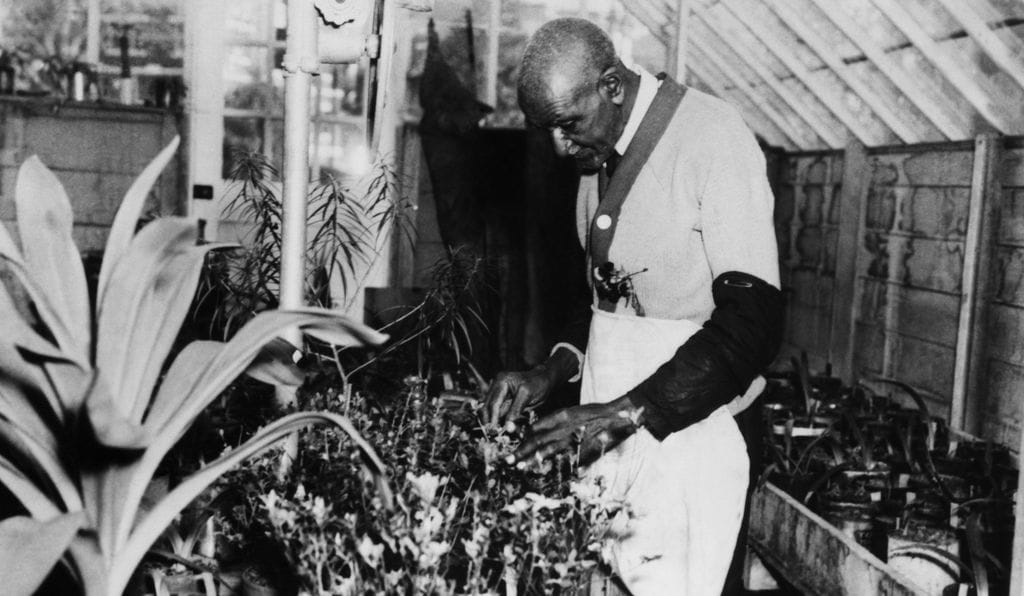
Despite this violence, and living his whole life in an openly white supremacist society, Carver went on to do trailblazing and visionary work as a gardener, scientist, and artist. He advocated over decades for cotton monocropping to be replaced by biodiverse, regenerative farming practices. He gave extensive testimony before congress on the topic of peanut cultivation and tariffs. (Hence his fame as the peanut guy.) He was an early mycologist. He was a prolific educator who brought his “Jesup Wagon”—a school on wheels—to rural Black communities, schools, and farmer’s picnics. And he invented a process of turning Georgia clay into pigment as intense as lapis lazuli—”Dr. Carver’s Egyptian Blue, Oxidation #9.”
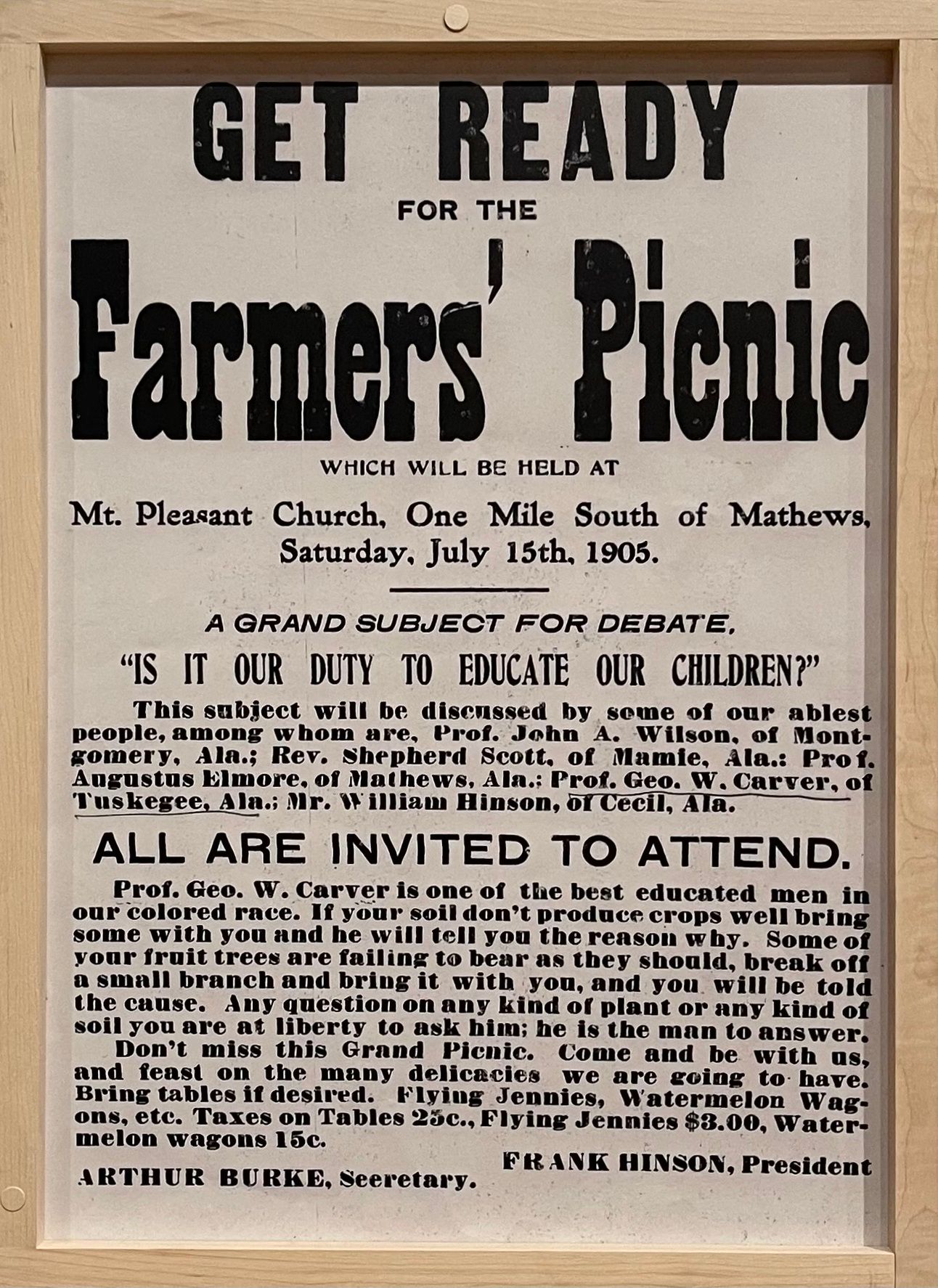
The exhibit opened up a whole world, not just of the many things Carver made in his lifetime but also of the dozens of artists the museum had invited to make works responding to his legacy. But what most inspired me was something much more modest: a complete set of 43 saddle-stitched booklets, printed on cheap paper, each one roughly six inches wide and nine inches tall.
These were the Bulletins published between 1898 and 1942 by the Agricultural Research and Experiment Station at the Tuskegee Institute. Carver founded that Station, at the invitation of the Tuskegee Institute’s founding president, Booker T. Washington, and he wrote almost all of the Bulletins. In them he shares practical advice especially for poor farmers and homemakers getting by on extremely limited resources. This emphasis on thrift is there in the first bulletin, “Feeding Acorns” (1898), which advocates using the “great quantity of acorns produced in our oak forests, which have been hitherto practically a waste product,” as animal feed. Published 44 years later, the 43rd bulletin, “Nature's Garden for Victory and Peace” (1942), is a manual for foraging (or “wildcrafting” in today’s cursed parlance) vegetables in order to make up for wartime food shortages. The whole project is deeply humane. If someone was doing this work today, we would say that it operates at the intersection of food justice, environmental justice, economic justice, and racial justice.
So the Bulletins are good—but are they cool? Yes! There is something magical about the basic dimensions of the publishing project remaining the same for almost half a century, while the typography and design shift and grow. At times the Bulletin’s covers become more elaborate; at other times they become simpler and more refined. As printing technology advances, photographs start showing up on the covers. A few use striking red paper.
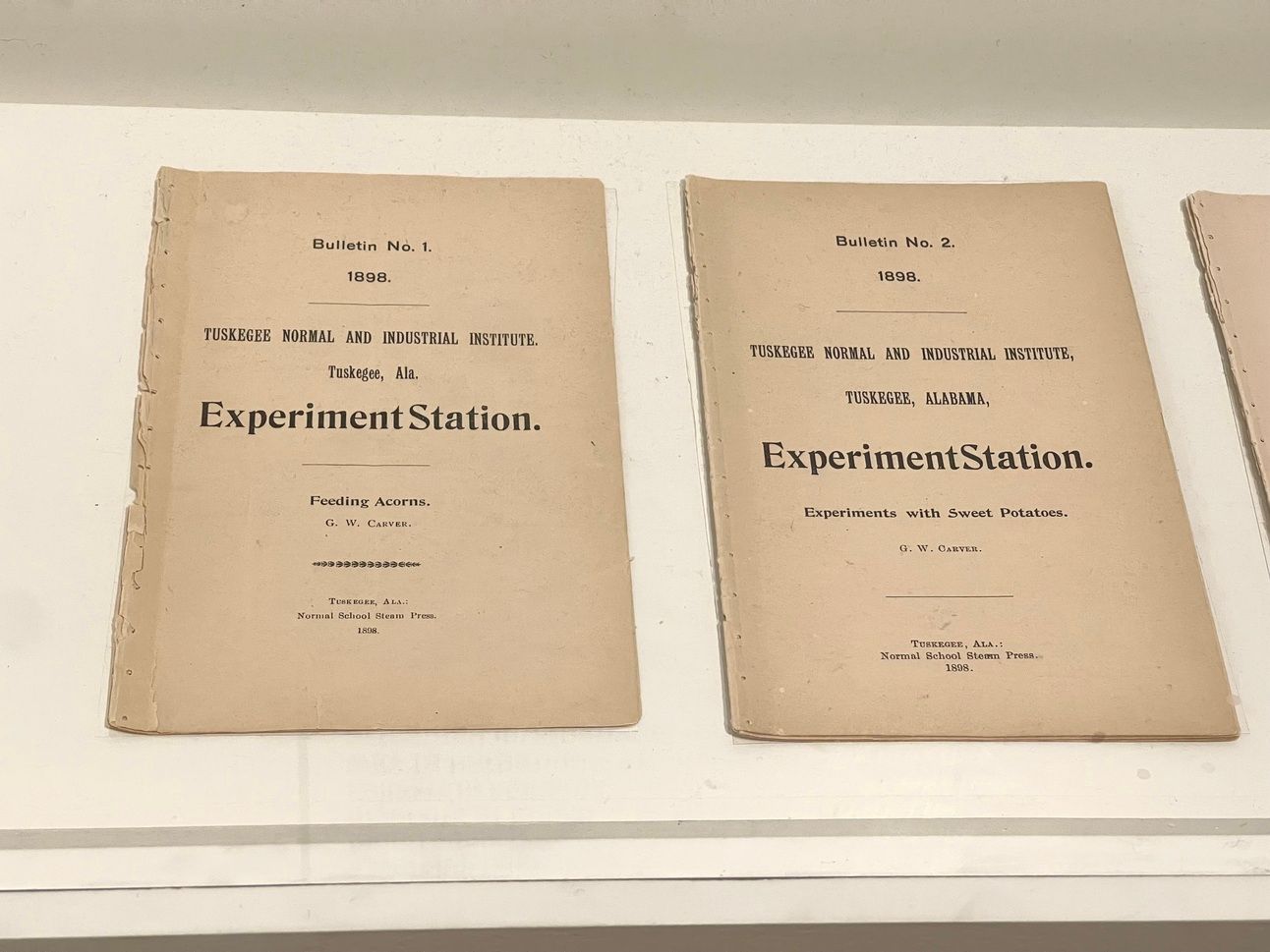


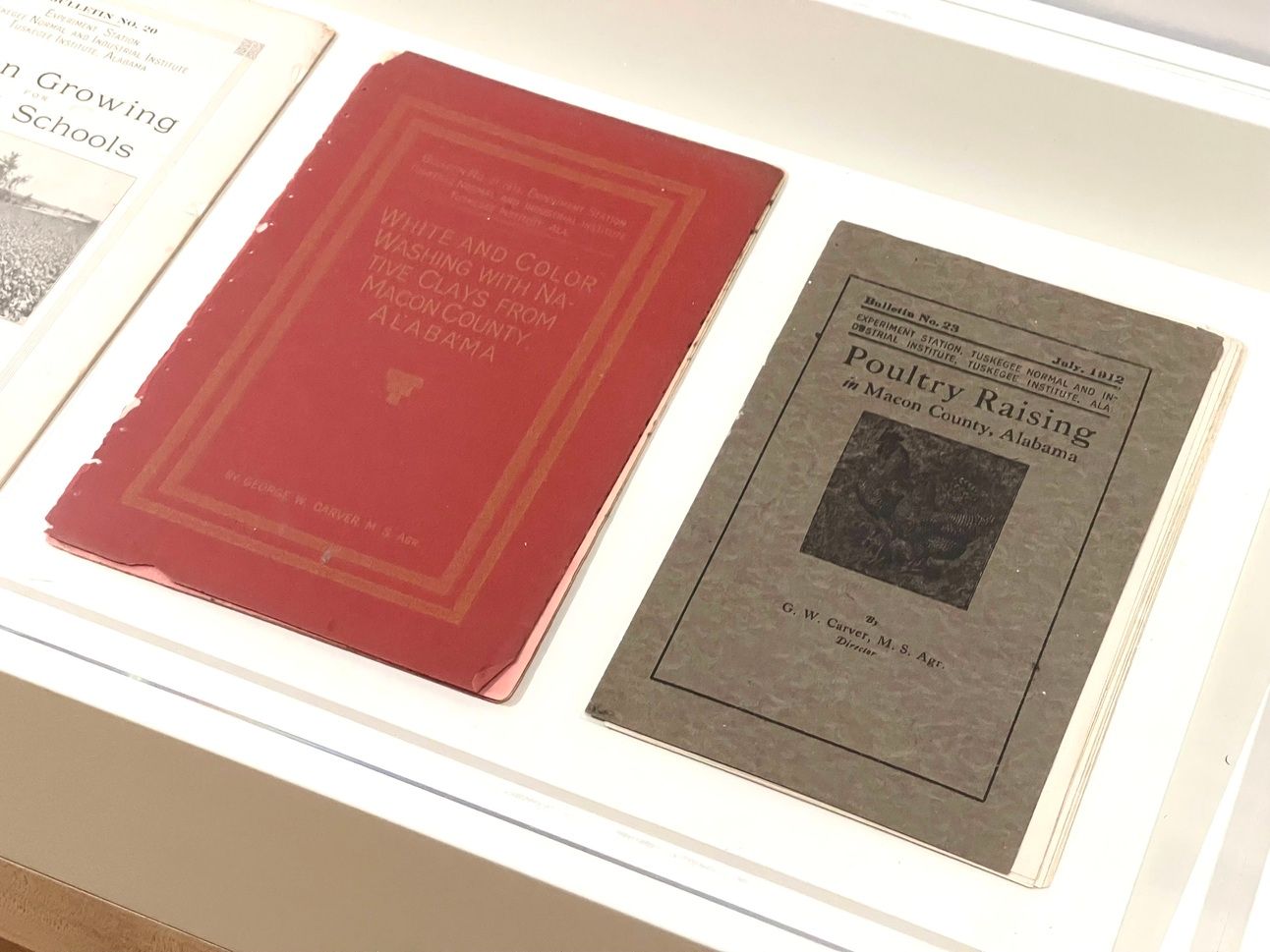
Look at these. You can feel the intelligence and care behind them. Each one was clearly the result of months of work and thoughtfulness. Can you imagine getting one in the mail? Sitting at your kitchen table of a Saturday morning, reading it, making notes in the margins in pencil?
The writing inside is thoughtful, too. In the 18th Bulletin, Nature Study and Gardening for Rural Schools (1910), Carver advocates for nature-based education, avant la lettre:
Nature study as it comes from the child’s enthusiastic endeavor to make a success in the garden furnishes abundance of subject matter for use in the composition, spelling, reading, arithmetic, geography, and history classes. A real bug found eating on the child’s cabbage plant in his own little garden will be taken up with a vengeance in the composition class.
Bug-motivated learning. This is right after my own heart!
But then there are also bits that seem funny, over a century later. In “How to Grow the Peanut: And 105 Ways of Preparing It for Human Consumption” (1917), there are recipes for a “Peanut Omelet” and “Peanut Macaroni and Cheese” and “Peanut Coffee.” But who knows, maybe I’m being close-minded, maybe they’re delicious?
Most of all, these Bulletins inspire me. How great, to see a life’s work accumulating in these small multiples, these little booklets made for normal people to read and refer to and enjoy. How much there is to learn from this example.
The Bulletins make me want to keep publishing my own work. I don’t pretend to think I can match Carver in polymathic energy and genius. At the same time, I wouldn’t wish on anyone the sorrows and oppression that Carver faced. But of course you don’t have to literally be George Washington Carver to make things as cool and necessary as these little booklets. The main thing I see running across these 43 Bulletins is persistence, care, and the drive to be useful to others. I’m so glad we have Carver’s example to draw on.

I launched a new podcast project. It’s called You Know What’s Good? Recent good things have included a gibbous moon on a windy night, watching workers move sheet rock, a mysterious voicemail, and a radio story that makes you cry.
My adjectives for the podcast would be: short, sweet, “bingeable”, mysterious, personal, and a touch of the ol’ ASMR. Give it a listen—and subscribe if you dare!

Kids say the darnedest things; it’s a fact universally acknowledged. Nevertheless, my two-year-old calling a Cybertruck a “Diaper Truck” might be an actual sign of genius.
Speaking of these vehicles that are so dangerous to pedestrians that they’re illegal on the entire continent of Europe, a recent 404 Media report on the vandalism and mockery being reported on a Cybertruck owners’ forum included one owner’s recording of his Cybertruck being flipped off by a man driving a budget sedan. Under that video, another Cybertruck owner commented this gem:
I am baffled at how any male can have that much audacity while driving a Ford Fiesta. Dude probably sits when he needs to take a piss
It’s almost like some people get their confidence from other places, right? (I might be deluded, though, as a proud Ford Fiesta driver myself...)
Boy, it’s a terrible, terrible political moment! I’m not focusing Lightplay in that direction right now, but I want to shout out three publications that I have been finding essential in these times: Jason Kottke’s kottke.org, Ryan Broderick’s Garbage Day, and Rusty Foster’s Today in Tabs. I’m sad that these publications—a “cool stuff” linkblog and two roundups of Internet/literary/shitposty drama—have had to pivot to covering the democracy beat. But with the big newspapers treating the ongoing coup with a stance I would describe as “blasé chic,” these three writers are doing key work in curating stories that, taken together, help me understand the big picture.
My partner and I first got into the comedian Conner O’Malley through his serialized vertical videos about being a disturbed, chino-wearing superfan of would-be presidential candidate Howard Schultz (“because only the coffee guy can defeat the covfefe man”). He has since then put out dozens of conceptually bizarre YouTube videos (“Smoking 500 Cigarettes for 5G,” “Top 10 Wisconsin Dells Haunted Houses For Free Pulled Pork”) in which he really claims the lane of deranged physical comedy about millennial masculinity. So we were delighted to find that his new film, “Rap World,” might be his best yet. Upsetting, hilarious—and so sharp. Part Safdie brothers quest cinema, part found footage / mockumentary / haunted fiction, and featuring some of the worst rapping you can imagine. Rating: must-watch.
(More than a few friends we’ve showed his stuff to just find it upsetting and not funny, so if you hate it, you were warned!)
Restaurant recommendation: Chengdu Taste in Alhambra. I haven’t had Chinese food this good since I was last in China, a decade ago. If you’re in greater LA, strong recommend checking it out. I was particularly delighted to once again have what their menu called “Garlic Arden Lettuce 蒜蓉A菜.” So green and bitter and garlicky-sweet and crunchy, the winning lottery ticket of leafy vegetables.
For a vegetarian like me, it doesn’t get better than good Chinese food. This meal reminded me of a James Beard quote: “In all the world there are only two really great cuisines: the Chinese and the French. China's was created first, untold centuries ago, and is judged to be the greater-when executed by superb chefs. It is the most complicated cuisine; it uses ingredients no other employs; and it is distinctive in that, for the most part, it is cuisine à la minute.” (I don’t know the source; it’s the epigraph of Mastering the Art of Chinese Cooking by Eileen Yin-Fei Lo.)

Erin Kissane’s latest essay, “Bad shape,” builds on her work around Meta’s role in the genocide of the Rohingya, and backs up a bit to look at social media writ large. She ends up arguing that the last fifteen years suggest that “platform corporations are structurally incapable of good governance, primarily because most of their central aims (continuous growth, market dominance, profit via extraction) conflict with many basic human and societal needs.”
I especially liked this passage:
A tractor structurally can't spare a thought for the lives of the fieldmice; shouting at the tractor when it destroys their nests is a category error. Business does business. The production line doesn't stop just because a few people lose fingers or lives. And what is a modern corporation but a legal spell for turning reasoning beings into temporarily vacant machines? We know this, which is why we have OSHA and the FAA and the FTC, for now.
In the latest n+1, the opening editorial (about Frederic Jameson and ways of seeing the present and the future) coins a new term:
…in one of the stealth editorials it calls ‘News Analysis,’ the Times proclaimed the end of the ‘Post-World War II Era of US Leadership’…
Stealth editorial! I’m immediately stealing that.
I also loved this towards the end of the piece:
No—real futurelessness is the terrain of the Democrats, a party stuck in a cycle of impotence that, come to think of it, resembles nothing so much as the contemporary English department: visionless, gerontocratic, hobbled by a structural incapacity to meet or even recognize its many sectoral crises.
n+1 is always a cover-to-cover read for me.
Speaking of newspapers, I finally canceled my Washington Post subscription. After many last straws, it was this bit from Jeff Bezos:
There was a time when a newspaper, especially one that was a local monopoly, might have seen it as a service to bring to the reader’s doorstep every morning a broad-based opinion section that sought to cover all views. Today, the internet does that job.
Get bent, loser! God I hate billionaires. Get rid of em! Let em just be $999 millionaires! There are worse fates!
As we wait to see whether Pope Francis will pull through, one more plug from n+1: “The Resurrection Appearance at Parque Lítico La Movediza” by Tom Bubul. This is from the Fall issue. The cover blurbed it as “Pope Fiction.” It’s… that.
(Also, check out Bobul’s website; that’s my jam!)
Why not put some chocolate chips and pomegranate molasses on your vanilla ice cream?
